


Cheap models are getting cheaper. AI is moving into your OS. Builders are fixing the last mile.
Three things happened in AI this week.
Most of the headlines focused on the launches.
I care more about what they tell us about where the money is moving.
Here are the three signals I’d pay attention to.
1. Cheap AI is getting cheaper. Expensive AI is still growing.
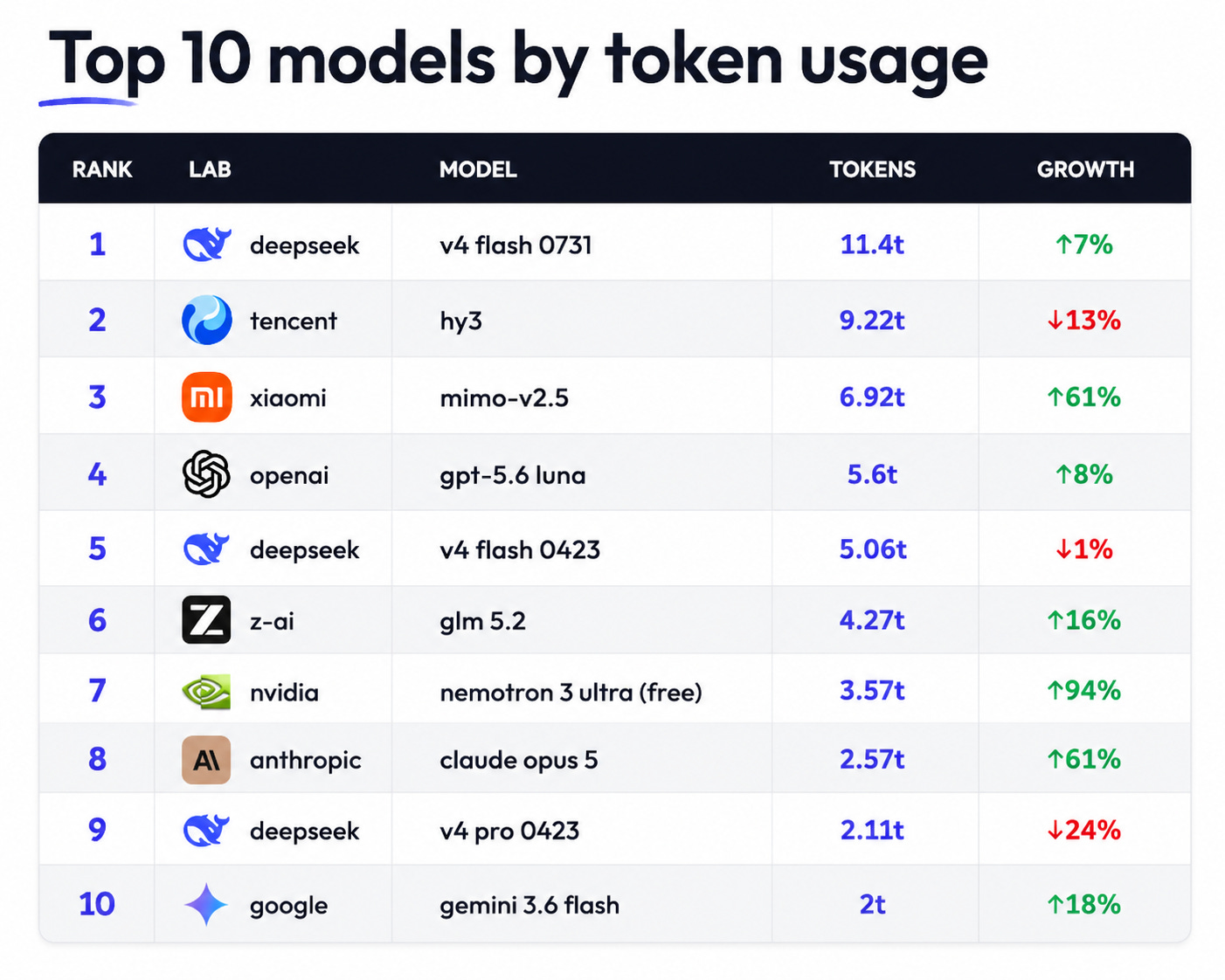
Look at the latest OpenRouter token leaderboard.
The cheapest models dominate usage.
DeepSeek V4 Flash.
Tencent HY3.
Xiaomi MiMo-V2.5.
GPT-5.6 Luna.
DeepSeek V4 Flash 0423.
Input prices across the top five range from roughly $0.065 to $0.20 per million tokens.
Xiaomi’s MiMo-V2.5 jumped from fifth to third after a price cut.
Nvidia’s free Nemotron 3 Ultra also jumped 94% to seventh.
So far, nothing surprising.
Then look at Claude Opus 5.
It re-entered the top 10 at number eight.
Usage jumped 61% in one week.
Its input price is $5 per million tokens.
That is far above the models above it.
People are still paying.
That tells you something useful.
AI is splitting into two markets.
One side wants the cheapest possible inference.
The other wants the best output for expensive work.
A developer building a toy chatbot can use the cheap model.
A company using AI for legal research, software engineering, financial analysis, or customer operations may care more about output quality.
That creates room for premium AI products.
If better output saves a client $20,000, paying more for inference is easy to justify.
The play:
Don’t build your product around the cheapest model.
Build around the result your customer cares about.
If the result is worth $10,000, spending a few extra dollars on better inference may be a very good trade
2. AI is disappearing into the operating system
Google launched system-wide AI dictation in July.
Hold a key.
Speak.
Get cleaned-up text wherever your cursor is.
No separate AI window.
No new tab.
No copy-pasting.
Meta is now moving in the same direction on Mac with Muse Spark.
The interesting part isn’t the dictation.
Meta is also connecting AI to business data.
Merchants can connect Instagram, Facebook ad campaigns, and Google Workspace.
Then ask the assistant for performance data, audience metrics, and competitor information.
One interface.
Multiple systems.
That’s the direction I would watch.
AI doesn’t always need another app.
It can sit inside the software people already use.
That matters because changing user behavior is expensive.
If someone has to open your app, copy data, paste it, wait, then move the result back...
You have added friction.
If your product works inside their existing workflow...
You removed it.
The play:
Look at the workflow your product targets.
Count how many times the user has to leave their current tools.
Then ask:
Can my product work inside the workflow instead?
That could mean:
browser extensions
Slack apps
Gmail integrations
VS Code extensions
Google Workspace add-ons
Mac menu bar tools
API integrations
The less behavior you change, the easier adoption becomes.
3. The GitHub repos growing fastest are solving boring problems
Five projects caught my attention this week.
Added 14,397 stars.
It now has around 24,000.
It is a Claude Code skill for generating diagrams in HTML and SVG.
Added 10,183 stars.
It has been around for years.
Developers still need APIs.
Added 7,380 stars.
Now above 112,000 stars.
It automates short-video production from a topic through scripting, footage, subtitles, and music.
Semantica
Added 4,005 stars.
It focuses on knowledge graphs, provenance, audit trails, and explainable AI.
Added 3,838 stars.
It is a tiny model designed to run on microcontrollers.
The common thread is simple.
None of these projects needed to build the next frontier model.
They solved a specific problem around existing AI.
That’s where I see a lot of room for builders.
Claude can write code.
Someone still needs to make that code generate the right diagram.
AI can generate video.
Someone still needs to build the workflow that takes a topic to a finished video.
Models can reason.
Someone still needs to make them work on tiny devices.
That gap is where products get built.
The play:
Don’t ask:
“What AI product should I build?”
Ask:
“What can AI already do that is still annoying to use?”
Then fix that one part.
Featured Tools
The tools serious builders are using right now.
FocuSee - Record your screen and get polished videos automatically. Perfect for creating product demos, tutorials, and share-ready content in minutes.

Promptfoo - Test, evaluate, and red-team your LLM apps with automated evaluations and security checks.
Sourcery - AI-powered Python code review and refactoring that helps developers clean up code and improve quality faster.
Shift AI - AI built directly into your browser workflow so you can summarize, write, and research without switching tabs.
❤️ Founders & AI Builders
Built an AI product?
Want to reach 60,000+ AI builders, founders, and developers?
👋 Reply to this email to collaborate.
📩 Quick favour
If this landed in Promotions, drag it to Primary so you don’t miss the next issue.