

AI Cheatcode — AI isn’t experimental anymore
The year AI stops assisting… and starts operating.

Every new year comes with noise.
Predictions. Hot takes. “This will be the year of X.”
But 2026 doesn’t feel like a prediction year.
It feels like an execution year.
AI is no longer about what’s possible.
It’s about what’s deployable.
Today’s four updates all point to the same shift:
AI is moving from tools → to operators.
And the people who win in 2026 will be the ones who build systems around that reality.
Let’s start the year right.
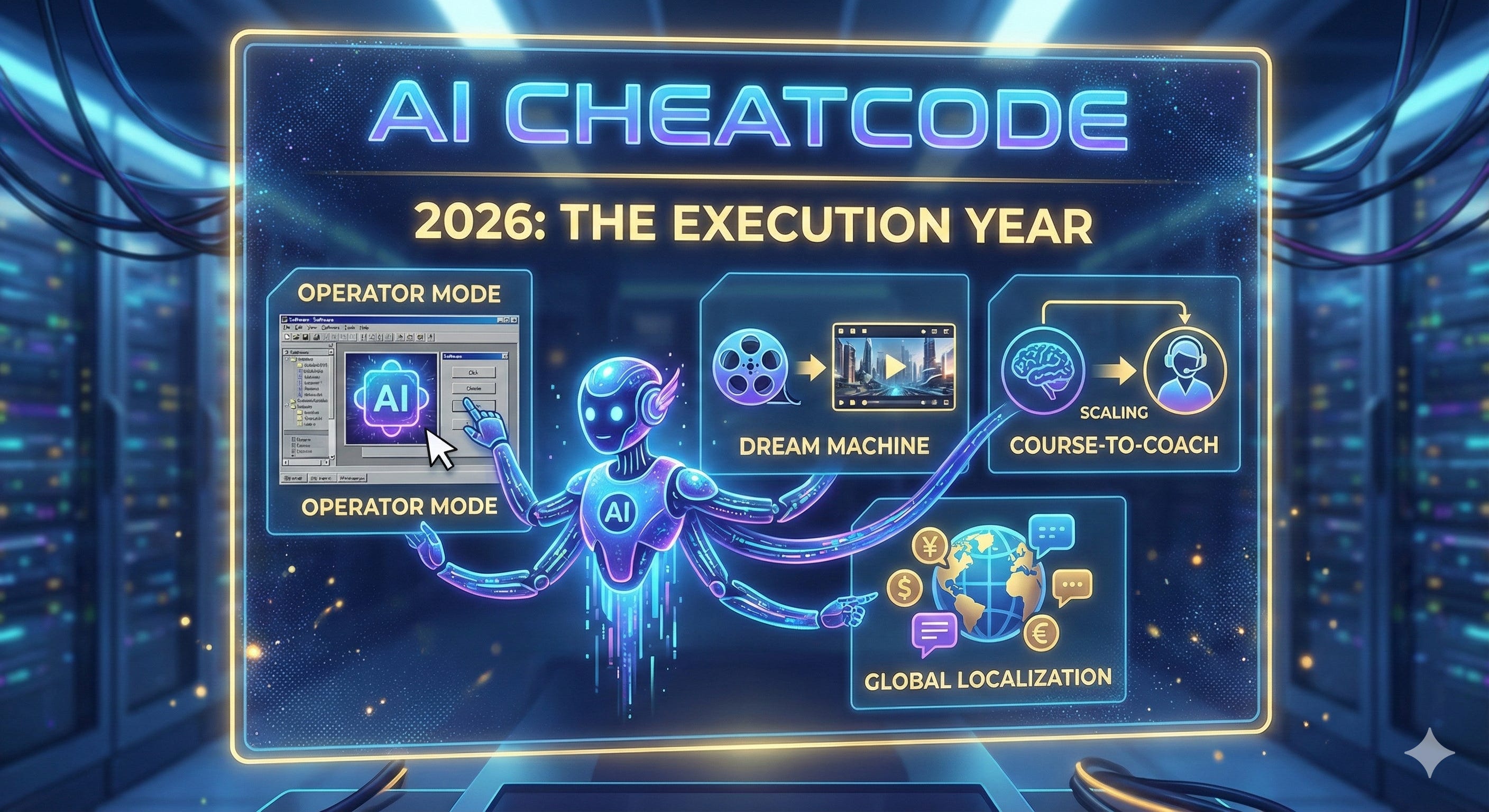
1. ChatGPT’s New “Screen Reader” Can Control Any App
This is one of the most important updates OpenAI has shipped, and it’s flying under the radar.
ChatGPT can now see and interact with your screen.
Not just read text.
Not just suggest steps.
Actually click buttons, navigate apps, and complete workflows the way a human would.
What this unlocks:
AI that fills forms across legacy software
AI that uses tools without APIs
AI that operates dashboards, CRMs, ERPs, and admin panels
AI that automates workflows companies assumed were “un-automatable”
This is the bridge between AI intelligence and real-world execution.
In 2026, automation won’t require integrations everywhere.
If a human can do it on a screen, AI can now do it too.
That’s a foundational shift.
2. Luma’s “Dream Machine” Is Now Open to All
High-quality AI video just crossed a major threshold.
Luma’s Dream Machine is now publicly available, and it’s setting a new standard for cinematic, realistic video generation.
What stands out:
Natural camera movement
Temporal consistency (scenes actually flow)
More believable motion and lighting
Outputs that feel closer to film than “AI video”
This matters because video is no longer a bottleneck.
In 2026:
Courses won’t need studios
Ads won’t need shoots
Explainers won’t need agencies
One script → one prompt → production-ready video.
The barrier to entry for visual storytelling just collapsed.
3. AI-Powered “Course-to-Coach” Conversion Funnels
Here’s a monetization pattern that’s quietly working extremely well.
Creators with courses are realizing something:
Courses scale… but coaching converts better.
AI now makes it easy to turn a static course into a high-ticket coaching engine.
The model:
AI summarizes each lesson into personalized action steps
Users answer reflection questions
AI flags where they’re stuck
You step in as the human coach, only where it matters
Result:
Less time spent coaching
Higher perceived value
Better outcomes
Higher price points
AI handles the repetition.
You handle the judgment, context, and accountability.
This hybrid model is going to define premium education in 2026.
4. The “AI Localization” Agency for SMBs
Global isn’t optional anymore, but most small and mid-sized businesses aren’t ready for it.
They don’t need translation.
They need local relevance.
This is where AI localization agencies come in.
What SMBs are paying for:
Culturally adapted landing pages
Localized ad copy (not word-for-word translations)
Region-specific SEO and keywords
Local tone, idioms, and buying triggers
Multilingual video voiceovers and scripts
AI makes this fast.
Human oversight makes it accurate.
In 2026, the winning agencies won’t be generalists.
They’ll be distribution specialists for global markets.
This is a massive, under-served opportunity.
🧭 The 2026 Playbook (My Take)
Here’s the throughline across all four updates:
AI can see (screens)
AI can create (video)
AI can support humans at scale (education)
AI can expand businesses globally (localization)
The winners this year won’t ask:
“Can AI do this?”
They’ll ask:
“How do I wrap a system, service, or product around this?”
That’s the game in 2026.
❤️ Founders & AI Builders — Get Featured
If you’re building an AI tool and want exposure to 47K+ AI-first readers and 200K+ monthly views, you can sponsor an upcoming issue of AI Cheatcode.
📩 Quick Favor (New Year, New Habit)
If this landed in your Promotions tab,
drag it to Primary so you don’t miss what’s coming next.
2026 is going to move fast.
AI Cheatcode will help you move faster.
Love that you’re leaning into region-specific SEO and local tone – that’s exactly where things are quietly shifting.
With AI search/recommendation getting better, a lot of discovery now happens via “answer-style” results rather than classic blue links. That’s where Answer Engine Optimization (AEO) comes in – basically structuring content so AI systems can understand *who* it’s for (e.g., a specific city/region) and *what* it’s best at.
A free tool that’s been useful for stress-testing posts through that lens is https://aeoanalyzer.app – helps see how clearly content signals topic, audience, and intent for AI engines.
Could pair nicely with your monetization experiments by making sure each piece is hyper-clear about region, use case, and outcome.
From possible to deployable is the line everyone's watching right now.
Tools that operate instead of assist change the entire job to be done.
More on AI Readiness: https://vivander.substack.com/p/stop-measuring-ai-success-like-your