

How AI Agents Are Quietly Reshaping Business

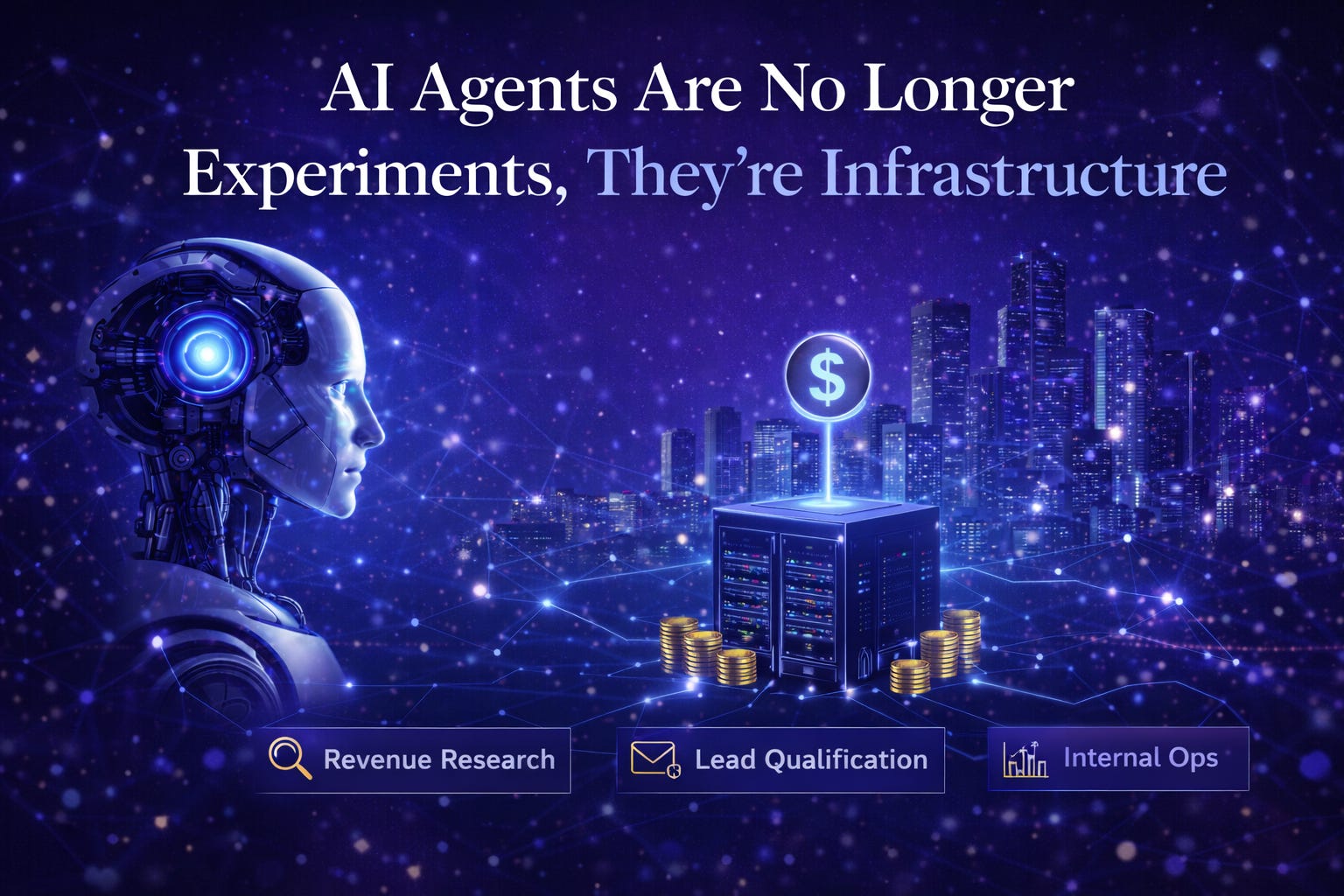
AI Agents Are No Longer Experiments, They’re Infrastructure
We crossed 55,000+ subscribers this week.
And something interesting happened.
After the last issue, a reader emailed me this:
“We are particularly interested in the possibilities offered by AI agents to generate revenue and improve business processes… We believe AI can be a significant lever for improving our efficiency and profitability.”
That email matters.
Because it shows something important:
AI agents are no longer curiosity tools.
They’re being evaluated as core business infrastructure.
Today, we’re going deeper into that shift.
🧠 1. AI Agents: From Side Project to Revenue Engine
The biggest change I’m seeing?
Companies aren’t asking:
“Can AI write content?”
They’re asking:
“How can AI replace friction inside our operations?”
That’s a completely different mindset.
Here’s how serious teams are using AI agents right now:
🔹 Revenue Research Agents
Monitor competitors
Identify pricing gaps
Track ad creatives
Generate weekly strategy reports
This becomes:
Competitive Intelligence as a Service
🔹 Lead Qualification Agents
Read inbound emails
Score intent
Ask contextual follow-up questions
Book meetings automatically
This removes human bottlenecks and increases conversion.
🔹 Internal Ops Agents
Automate recurring reporting
Generate client recaps
Sync dashboards
Create structured SOPs
This is what increases profitability quietly.
The companies winning right now aren’t experimenting.
They’re embedding.
💰 2. $110B Investment Pushes OpenAI to $730B Valuation
OpenAI’s valuation reportedly jumped to $730 billion following a massive $110B investment wave.
Pause and think about that.
That’s not hype money.
That’s infrastructure money.
Capital flows where:
Compute demand is real
Enterprise contracts are locked
Recurring usage is predictable
The takeaway isn’t “OpenAI is big.”
The takeaway is this:
AI is no longer treated like software.
It’s treated like electricity for business.
When infrastructure consolidates at that level, opportunity moves downstream.
The leverage shifts to:
Builders
Integrators
Workflow designers
Agent architects
That’s you.
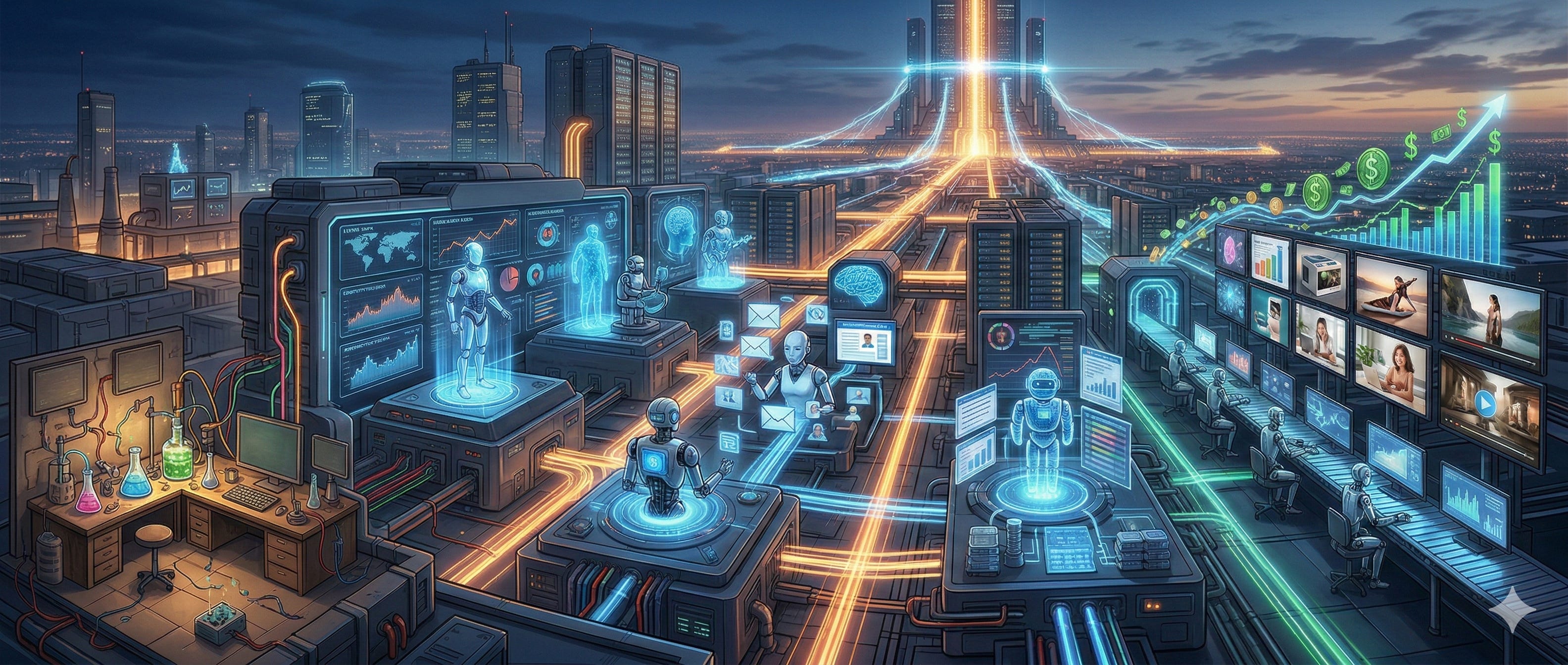
🎨 3. Using Image AI Tools to Generate Ads (The New Creative Arbitrage)
This is one of the most underpriced opportunities right now.
Image AI tools can generate:
Hyper-real product mockups
Lifestyle ad creatives
UGC-style thumbnails
Cinematic brand visuals
And here’s the real play:
You don’t sell “AI images.”
You sell conversion-ready ad concepts.
The Simple Model
Study 20 winning ads in a niche
Reverse-engineer:
Composition
Lighting
Emotion
Offer positioning
Generate 5–10 variations using AI
Deliver to brands as:
“Ad Creative Pack”
“Testable Campaign Assets”
Charge:
$500 – $3,000 depending on niche.
AI reduces production cost.
You keep the margin.
That’s creative arbitrage.
🎥 4. Advanced Character-Swap Video Prompt (For Creators)
This section is for creators experimenting with motion transfer and character replacement workflows.
Here’s a structured Nano Banana–style pro prompt you can use for clean character swaps in video projects:
Prompt 1 (Image Preparation)
Swap my body with [swap character], keeping my head and face intact while preserving the background, lighting, and other elements unchanged.
Prompt 2 (Motion Transfer & Consistency)
Apply the exact movements, poses, gestures, and timing from the original video to the swapped character image. Preserve the original video’s motion fluidity, rhythm, and body mechanics without distorting the character’s proportions, face, or identity. Keep the background, environment, and camera motion locked to the original video.

Use the original video as the motion source with clear, full-body visibility and minimal occlusion. Map all tracked body movements (walking, hand gestures, head turns, posture shifts) onto the swapped character while maintaining accurate floor contact and preventing foot sliding.

Ensure the swapped character starts in a neutral pose aligned to the source video’s perspective and scale. Match body proportions (shoulders, hips, leg length, head size) to maintain natural motion transfer.

Enable identity/structure lock to prevent facial or body warping. Keep timing, pacing, and animation continuity identical to the source.

If facial expressions are included, preserve expression timing while maintaining the swapped face’s features.

Output should look like the swapped character naturally performed the original motion in the same scene.
Use cases:
Creative storytelling
Character-based marketing
Branded video experimentation
Meme-style engagement content
The real leverage?
When you combine:
AI image generation
Motion transfer
Ad strategy
You collapse production time from weeks to hours.
🧭 The Bigger Pattern
This week’s signals are clear:
Enterprises are embedding AI agents
Infrastructure capital is flowing aggressively
Creative production costs are collapsing
Reasoning models are becoming dependable
AI isn’t getting louder.
It’s getting deeper.
And the readers who emailed me last week?
They’re already thinking in systems.
That’s where the edge is.
🔁 If This Helped
If this clarified how AI can actually improve profitability, not just productivity:
👉 Share this with someone building in AI.
❤️ Founders & AI Builders — Get Featured
If you’ve built an AI tool and want to reach 55,000+ AI-first readers, you can sponsor an upcoming AI Cheatcode issue.
📩 Quick Favor
If this landed in Promotions, drag it to Primary
so you don’t miss the next drop of AI news, tools, and monetization plays.
“AI is no longer treated like software.
It’s treated like electricity for business”
this is a pretty interesting trend from what im seeing.
nice article thanks!