

How to Build an AI Research Agent That Actually Thinks

Last week, a founder told me this:
“Our customer research reports are just noise now.
Same pain points. Same quotes. Different dates.”
That’s when I showed him how to build an AI research agent, one that doesn’t just scrape data but learns from it.
Here’s the full system 👇
🚀 Step 1: Choose Your Data Sources
Every insight starts with where you listen.
Pick your goldmines, the places where your audience vents, dreams, and debates.
Start with:
Reddit (authentic, long-form pain points)
TikTok comments (raw emotional triggers)
YouTube comments (unscripted reactions)
Facebook ad comments (purchase objections)
Competitor Facebook ads (positioning clues)
The goal? Build your listening posts where real conversations happen.
⚙️ Step 2: Set Up Daily Scraping
Now we automate the ears.
Use APIs or third-party scrapers to pull new data from your chosen sources daily, not once a quarter.
Why daily matters:
You catch fast-moving trends before competitors.
You see emotional shifts in real time.
You feed your AI model fresh language patterns continuously.
You can use tools like Apify, Bright Data, or SerpApi to make this plug-and-play.
🗂 Step 3: Organize the Chaos
Now you’ve got thousands of raw comments.
Time to turn noise into structure.
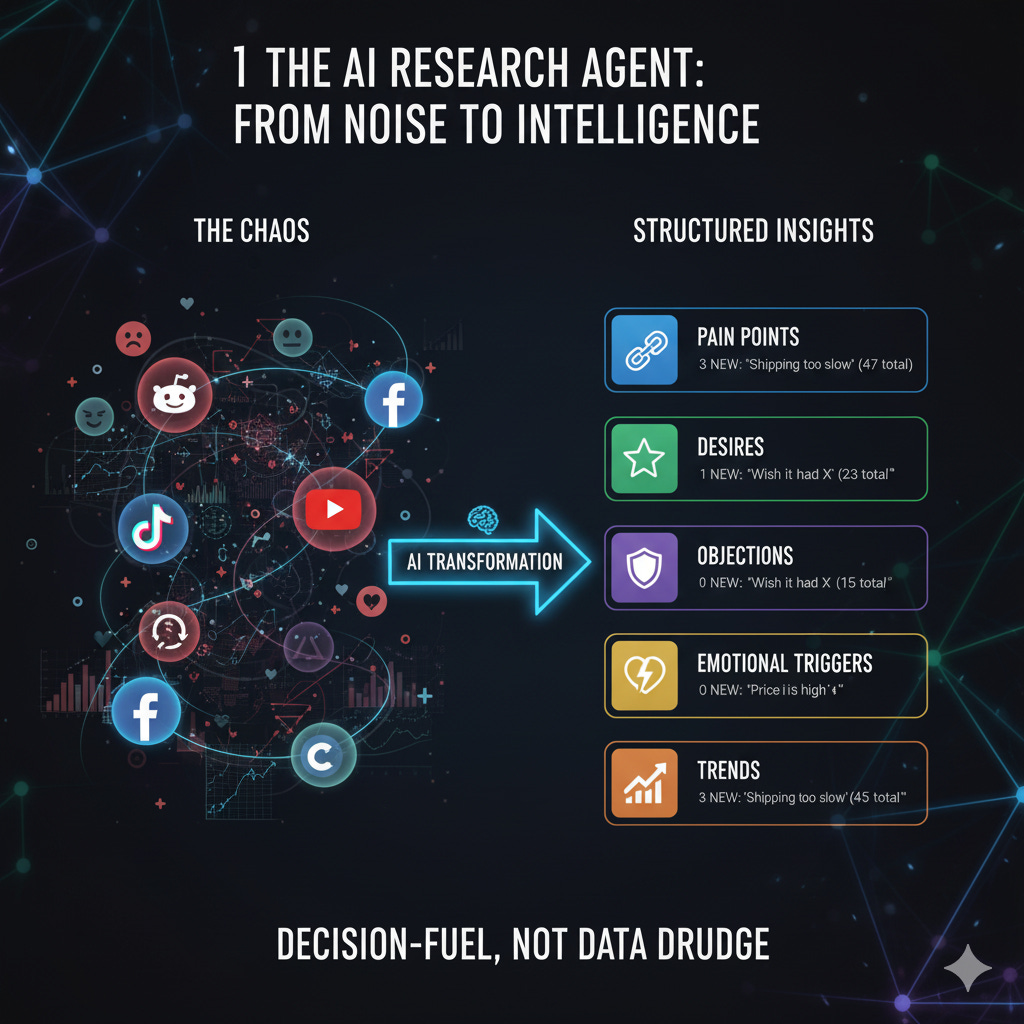
Use your AI agent to categorize findings into five sections:
Pain Points — current frustrations
Desires — what customers dream of achieving
Objections — reasons they hesitate to buy
Emotional Triggers — what actually moves them
Trends — emerging themes and cultural shifts
This turns random data into decision fuel.
📊 Step 4: Synthesize Into Daily Reports
Structure your AI’s daily output like this:
Pain Points: 5 new insights found
Desires: 3 new insights found
Objections: 2 new insights found
Emotional Triggers: 4 new insights found
Each insight should include short supporting quotes from the source.
That’s what makes your reports feel human, not abstract.
🔁 Step 5: Stop Repeating Yourself
Here’s the problem most research systems miss:
After a few weeks, you’ll start seeing the same insights over and over again.
“Customers are insecure about their acne.”
“Users find onboarding confusing.”
“People want faster shipping.”
And that’s when readers stop reading.
The solution? Duplicate detection.
🧩 Step 6: Build a Smart Knowledge Base
Feed every single insight into a central database.
Then use embeddings (via OpenAI, Pinecone, or Weaviate) to check each new finding against what’s already stored.
Example:
New insight: “Customers struggle with acne breakouts.”
System checks: found similar insight from 2 weeks ago → mark as duplicateNew insight: “Customers fear ingredient interactions.”
System checks: no match → flag as new finding
Now your reports only highlight what’s genuinely new.
🧠 Step 7: Show Both the Forest and the Trees
End each report like this:
Pain Points: 3 new insights (47 total)
Desires: 1 new insight (23 total)
Objections: 0 new insights (15 total)
This helps your readers track long-term patterns while focusing on what just changed.
🎯 The End Result
You don’t just have a “scraper.”
You have a thinking system.
An AI research agent that:
Grows smarter every day
Spots subtle shifts others miss
Keeps your marketing, product, and creative teams aligned on what actually matters
No more drowning in duplicate data.
Just clear, evolving intelligence you can act on. piece looks like a pro-grade newsletter issue.