

What Changed Quietly in AI

The models are getting smarter.
The leverage is shifting.
And most people are still playing catch-up.
Every few months, AI takes a step that quietly changes the rules.
Not with flashy demos.
Not with hype threads.
But with capability shifts that compound over time.
Today is one of those moments.
Let’s break down what actually matters, and how to use it.
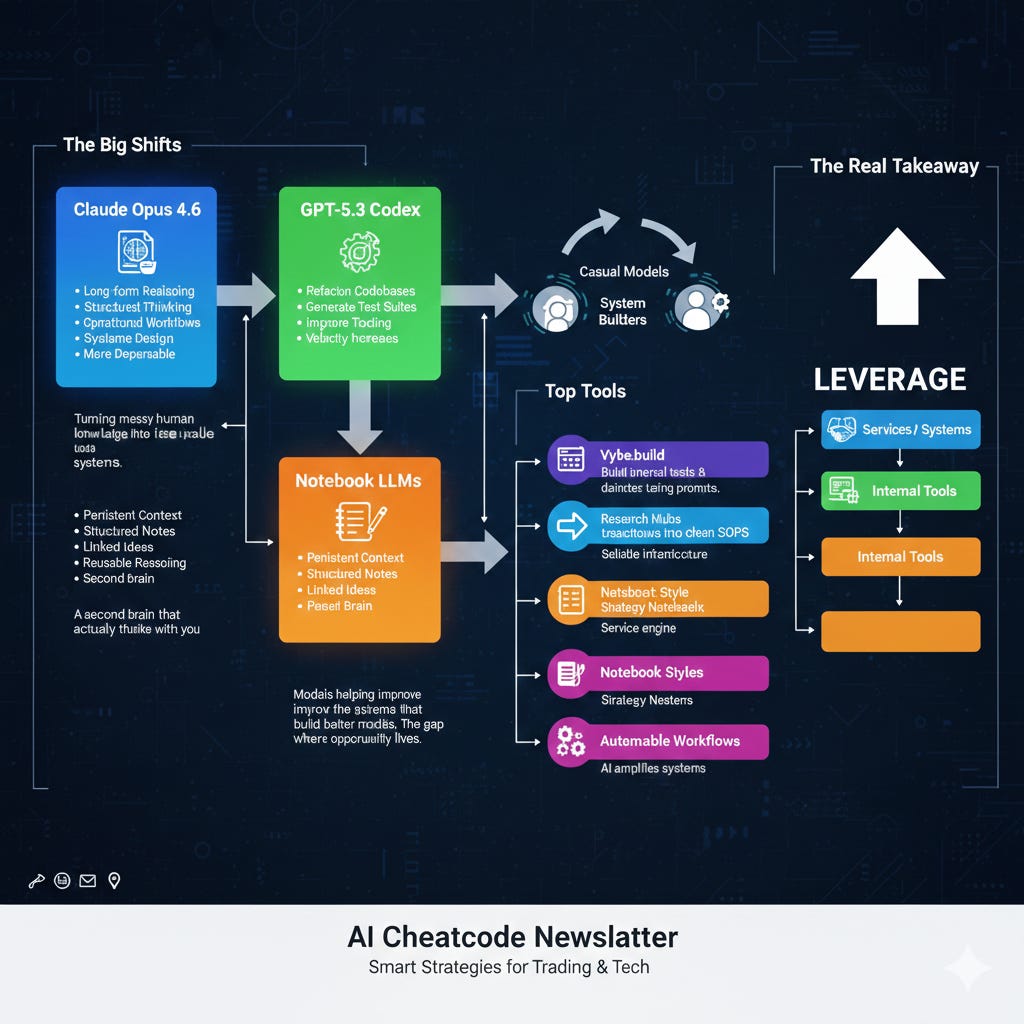
🧠 The Big Shifts You Should Care About
1. Claude Opus 4.6 Quietly Overtakes GPT-5.2 (In Practice)
On paper, benchmarks look close.
In practice, something more important is happening.
Claude Opus 4.6 is becoming the model people rely on for:
long-form reasoning
structured thinking
operational workflows
documentation, SOPs, and system design
It’s not louder.
It’s more dependable.
That’s why builders are increasingly using Claude not for “answers,” but for:
turning messy human knowledge into clean, usable systems.
The real competition right now isn’t who sounds smarter.
It’s who helps you ship clearer outcomes.
2. GPT-5.3 Codex Is the First Model Helping Create Itself
This is subtle, and huge.
GPT-5.3 Codex isn’t just writing code for users.
It’s being used internally to:
refactor codebases
generate test suites
improve tooling that trains future models
That’s a feedback loop.
Models helping improve the systems that build better models.
This doesn’t mean “AGI tomorrow.”
It means velocity increases.
And when velocity increases, the gap widens between:
people who use AI casually
people who build workflows and systems with it
That gap is where opportunity lives.
3. Notebook LLMs Are Becoming the New Control Center
Quiet trend you should not ignore:
Notebook-style LLMs.
Instead of chat-only interactions, people want:
persistent context
structured notes
linked ideas
reusable reasoning
Notebook LLMs act like:
a second brain that actually thinks with you, not just responds.
This is especially powerful for:
research
content systems
strategy work
long-term projects
The future isn’t “one perfect prompt.”
It’s persistent intelligence with memory and structure.
🧰 Top Tools Worth Your Attention Right Now
Here’s a short, practical stack — no fluff.
⚙️ Vybe.build
Build internal tools and dashboards in minutes using prompts.
Perfect for:
client dashboards
internal ops tools
quick MVPs you can sell
This is sellable infrastructure, not demos.
⚙️ Glitter AI
Turn real workflows into clean SOPs automatically.
Best used as a service engine, not just a productivity tool.
If you’re selling:
operations
onboarding
internal systems
Glitter lets you deliver 10× faster.
⚙️ Notebook-Style LLMs
Use them as:
research hubs
strategy notebooks
long-running project brains
This is where serious thinking is moving.
⚙️ Automation Builders (Make / Zapier-style tools)
Still underrated.
When combined with strong models, they let solo operators:
replace junior roles
ship faster
scale without hiring
AI doesn’t replace systems.
It amplifies them.
🧭 The Real Takeaway
Models will keep improving.
That part is inevitable.
What’s optional is whether you:
consume updates
or turn them into leverage
The winners aren’t chasing every new release.
They’re building:
services
systems
internal tools
repeatable workflows
…on top of these shifts.
That’s how AI turns from “interesting” into income-producing.
🔁 One Ask
If this helped you see where AI is actually heading (not just what’s trending):
👉 Share this with a friend who wants leverage, not more noise
❤️ Founders & AI Builders — Get Featured
If you’ve built an AI tool and want to reach 51,000+ AI-first readers, you can sponsor an upcoming AI Cheatcode issue.
📩 Quick Favor
If this landed in Promotions, drag it to Primary
so you don’t miss the next drop of AI news, tools, and monetization plays.
this is really true around notebookLM. nice update here :)